Industrial Resin Floor Preparation: Why Is It Important?
What is Industrial Resin Floor Preparation?
Resin floor preparation is the mechanical process of opening up the concrete surface so that resin can bond to it. It removes the weak and contaminated top layer, exposes sound concrete, and creates a textured profile for the primer to key into.
Floor preparation is not cleaning; it means taking material off the top of the concrete, mechanically and under control.
How proper preparation is done
The method depends on the slab, the contamination and the system going down.
Diamond grinding
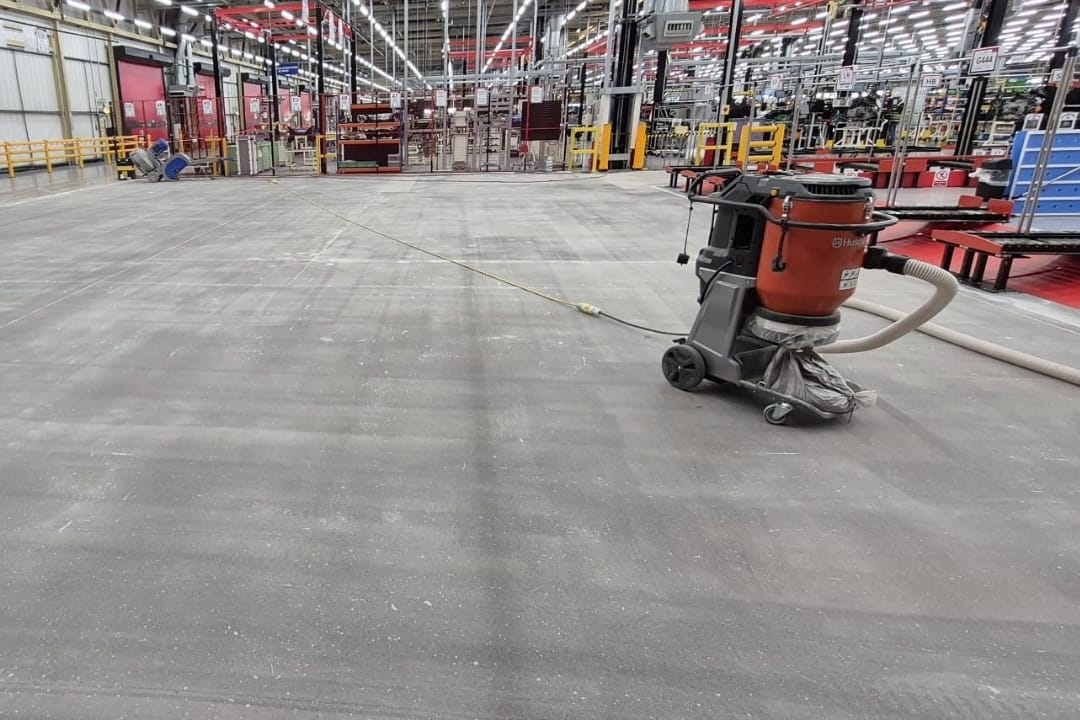
Known as the workhorse. Rotating diamond segments remove laitance, coatings and contamination and leave a consistent, keyed surface. It is controllable, works right up to walls and around plant, and with vacuum extraction it produces very little airborne dust.
Captive shot blasting
This fires steel shot at the surface and recovers it and the debris in the same pass. It covers large open areas quickly and produces a deeper, more aggressive profile, which suits heavier build systems and screeds. It is used as per FeRFA requirements on larger projects.
Other floor preparations
Alongside these, other preparation includes crack and joint repair, removal of contaminated concrete where it has penetrated too deep to grind out, filling and levelling where the slab has fallen away, and thorough vacuuming of all particulates before priming.
In plain terms, it is how rough the prepared surface is, measured on a recognised scale. A thin coating needs a light profile. A trowelled screed needs a much deeper one. Matching the profile to the system is what makes the bond reliable, and it is one of the more common things to be got wrong by contractors who treat preparation as a box-ticking exercise.
How preparation shows up in the finished floor
You will not see the preparation. You will see what it delivers.
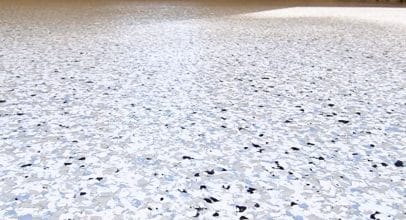
A properly prepared substrate gives you consistent thickness, because the resin is going down onto a uniform surface rather than filling in hollows and thinning over high spots. It gives you an even appearance, without the patchy sheen that comes from variable absorption.
Most importantly, it gives you a bond that holds under forklift traffic, thermal movement and daily cleaning for the life of the floor.
Preparing a screed rather than a slab
Not every resin floor goes onto structural concrete. Where a levelling or smoothing screed has been laid, floor screed preparation follows the same principles but needs a lighter hand.
Screeds are softer than concrete, so aggressive grinding can cut straight through a thin section. They also have to be fully cured and dried before anything goes over them, and the drying time is often longer than people allow for.
The practical points are the same as with a slab. Check what the screed actually is, confirm it is sound and well bonded to whatever is beneath it, remove the surface layer mechanically rather than chemically, test for moisture, and prime with a product suited to the material. Where a screed is unsound or debonded, no amount of preparation will save it, and it needs taking up.
What poor resin floor preparation looks like
Laitance left in place
Fresh concrete brings fine cement particles to the surface as it cures, forming a weak, dusty layer. Resin will bond to it perfectly well. The trouble is that the laitance is barely bonded to the concrete beneath, so the whole lot lifts together under traffic.
Contamination not properly removed
Oil, grease, coolant, silicone and old curing compounds all sit in and on industrial slabs. A light grind takes off the surface but not always the depth of penetration. Resin laid over contaminated concrete simply will not stick in those areas, and you get peeling that maps neatly onto your machine layout.
Insufficient surface profile
Resin needs a mechanical key, not just a clean surface. Different systems need different profiles, and a thin coating over glass-smooth power-floated concrete has very little to hold onto.
Cracks and defects coated over
Cracks move. Coat over one and it will telegraph through the new floor, usually within the first few months. Spalled areas, blown patches and failed joints do the same.
No moisture testing
Preparation is the natural point at which the slab is exposed and testable. Skipping the test here means specifying blind, and moisture is the most destructive failure mode there is.
Our process
We survey the substrate first, meaning checking the condition of the concrete, testing for moisture, identifying contamination, and looking at joints, cracks and any previous coatings.
Preparation is then written into the specification as a defined stage of the works, with the method, the target profile and any repairs set out. It is carried out by our own team with our own equipment, all dust extracted, keeping the surrounding areas of your site workable while we get on with it. Our site supervisors are CITB SSSTS and SMSTS trained, and we work in line with the FeRFA Code of Practice throughout.
To find out more about our resin floor preparation process and services, contact us below.