Reflooring a Live Factory: Replacing factory flooring without shutting down
The cost of a factory flooring replacement
Ask most operations managers what stops them replacing a failing floor and the answer is not the quote. It is the two weeks of lost output, the orders that slip, the agency staff stood down and the customers who have to be told.
In practice, a full shutdown is usually avoidable. With the right sequencing and the right resin systems, most factory flooring and warehouse flooring can be replaced around production rather than instead of it. It takes more planning and it needs a contractor who is willing to work to your schedule rather than their own, but it is routine work for experienced industrial flooring contractors.
How phased installation works
The principle is straightforward: split the floor into zones and do them one at a time, so the building never loses more than a fraction of its area at once.
Zoning the floor
We divide the area into workable sections, sized around what can be prepared, laid and returned to service within the window available. Zone boundaries are set at natural breaks such as bay lines, aisles, racking runs and existing joints, so the finished joints fall where they will not be noticed and will not sit under a wheel line.
Working around the schedule
Weekends, night shifts, planned maintenance shutdowns, seasonal quiet periods and the gaps between production runs all provide windows. Many jobs are done entirely outside normal operating hours, with the site handed back each morning.
Sequencing
Each zone is fully complete and back in service before the next begins. That means preparation, repair, priming and laying all happen inside one window rather than leaving a half-finished area exposed. Racking is moved section by section, stock is decanted into the zones already finished, and traffic routes are diverted around the live work area.

Fast floor curing systems that make it possible
MMA flooring
This cures in around an hour and will go down at temperatures as low as minus 20 degrees, which makes it the obvious choice for cold stores and for genuinely tight overnight windows. Its drawback is odour, which is strong during application and needs proper ventilation and planning around occupied areas.
Polyaspartic flooring
This cures in one to two hours, has no significant odour, and is UV stable. It suits daytime work in occupied buildings and single-shift turnarounds where MMA would be difficult.
Polyurethane and epoxy flooring
Polyurethane and epoxy still have their place. Where a zone can be handed over after 24 hours, or where the environment demands the chemical or thermal performance those systems provide, they remain the right specification and the programme is built around them instead.
Each flooring option still has its requirements. We would not put MMA into a building simply because it is fast if a polyurethane screed is what the process actually needs. We would zone the work more tightly instead.
Managing the site around live operations
Working in an occupied factory is as much about control as it is about flooring.
Dust
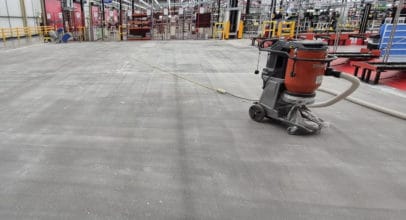
Preparation is the dustiest part of the job, and it is the part that will get you stopped if it is not handled. All of our diamond grinding runs with vacuum extraction, and our machines operate under 85dB, which keeps both dust and noise inside acceptable limits alongside live production.
Odour and ventilation
Where a fast-cure system is being used, we plan extraction and ventilation in advance and agree which adjacent areas need to be clear during application and for how long.
Segregation
Barriers, signage, protected walkways and agreed diversion routes for both pedestrians and forklift traffic. Work areas are sealed off properly rather than coned.
Coordination
Our site supervisors are CITB SSSTS and SMSTS trained and work directly with your own health and safety team, attending inductions, following site rules and issuing method statements and risk assessments before we start. We are SafeContractor approved and an Environment Agency registered waste carrier, so waste from the old floor leaves site properly documented.
Our process
We first survey the site and look at the substrate and test for moisture. We also walk the building with you to understand how it works: where the traffic goes, what cannot stop, where stock can be moved to, when the quiet periods are, and which areas can realistically be given up and for how long.
From that we produce a phasing plan, agreed with you before anything starts. It sets out which zones go in which order, what we need access to and when, what you need to clear and by when, and when each area comes back into use.
Preparation, repair, membranes and installation are all carried out in-house by our own team, which keeps the programme in one pair of hands. On completion, our team carries out a full inspection of each zone and provides maintenance information for the system installed.
To find out more about our factory flooring repair and installation services and the industries we cover, contact us below.