Common Causes of Epoxy Floor Peeling
An epoxy floor coating is a two-part resin system, mixed on site and applied over prepared concrete, that cures into a hard, chemical-resistant, jointless surface. It is the most widely used industrial epoxy flooring build-up in the UK. Its whole performance rests on one thing: the bond between the resin and the slab underneath. Epoxy peeling is when that bond lets go.
How peeling can start on epoxy flooring
Peeling and delamination from the substrate
This is the coating losing its grip on the concrete. Lift a piece, and you will see bare grey slab underneath, often with no resin left on it at all.
Intercoat failure
This is the coating splitting within itself, usually between a primer and a body coat or between a body coat and a topcoat. Lift a piece here, and there will still be resin firmly stuck to the concrete beneath.
The distinction matters because the causes are different, and so is the fix. In almost every case, though, both point back to something that went wrong before the resin was laid rather than to the material itself.

The main causes of epoxy floor peeling
These are the five we see most often, roughly in order of how frequently they turn up.
Inadequate surface preparation
Concrete has a weak, dusty layer of laitance on the surface, and industrial slabs accumulate curing compounds, sealers and general contamination on top of that. Resin bonded to that layer takes the layer with it when it goes. Acid etching and light sanding do not remove enough of it. Mechanical preparation to a suitable concrete surface profile does.
Moisture in the slab
Water vapour rising through concrete, under a sealed coating, builds hydrostatic pressure, which lifts the resin off the slab. Typical culprits are a missing or failed damp-proof membrane, a ground-bearing slab, and new concrete coated before it has dried out. Blistering that appears in patches and feels damp underneath is the signature.
Contamination from oil or grease
Oil penetrates deeply into industrial concrete, and grinding the surface will not always take you below it. Coat over it and the resin simply will not bond in those areas, which is why this kind of peeling maps onto machine bases, hydraulic units and the routes trucks take.
Incorrect mixing ratios
Epoxy cures by chemical reaction in a fixed proportion. Too much or too little hardener, insufficient mixing time, unscraped sides on the pot, or material thinned to make it spread further all leave you with resin that never fully cures. Soft, tacky or chalky material is the result, and it has very little bond strength.
Applying outside the recommended conditions
Every system has a temperature and humidity window. Work below it and the cure stalls, leaving a surface prone to amine bloom which then blocks adhesion for the next coat. Work above it, and the pot life collapses before the material can be laid properly. Overrunning the overcoating window between layers causes intercoat peeling in the same way.

How to prevent epoxy floor peeling
1. Test the slab first
Relative humidity testing to BS 8203, plus a check for contamination and substrate soundness, before anything is specified.
2. Prepare mechanically
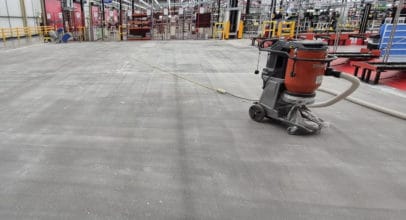
Diamond grinding or captive shot blasting to remove laitance and contamination and open the concrete to the correct surface profile for the system being used. This is not an optional extra; it is the foundation of the whole installation.
3. Prime correctly
A primer suited to the substrate condition, applied at the stated coverage rate and overcoated within its window.
4. Install a damp-proof membrane where the readings call for one
It costs a fraction of a re-lay, and it removes the single most destructive failure mode.
5. Follow the manufacturer’s cure schedule
Mix full batches, respect the ratio, work inside the temperature and humidity window, and observe the minimum and maximum recoat times.
6. Choose a system that suits the room
Where there is thermal shock, heavy chemical attack or daily hot wash-down, a standard epoxy may not be the right answer. Polyurethane, polyaspartic and MMA systems all handle conditions that epoxy struggles with.
What a properly bonded epoxy floor looks like
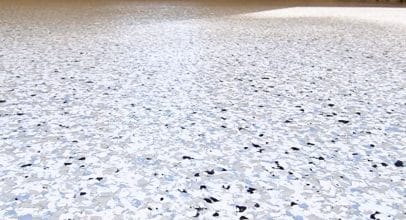
It sounds solid underfoot, with no hollow ring when tapped. There are no raised edges, no blisters, no soft or tacky patches. The coating is even in thickness and colour, and detailing at doorways, drains and columns is neat and continuous.
Correct preparation is what delivers all of that, and it is the reason a floor still looks like this after years of forklift traffic instead of lifting within months.
Our process
When we are called to a floor that has started peeling, the first job is working out why. We assess the existing coating, check adhesion, test the substrate for moisture, and look for contamination. Only then do we recommend anything.
Sometimes the answer is a localised resin floor repair, and sometimes the honest answer is that the whole coating has to come off and the floor needs laying again properly. We will tell you which, and why.
Preparation, repair and installation are all carried out by our own team using our own equipment, in line with the FeRFA Code of Practice.
To find out more about our epoxy flooring process and services, get in touch with us below for a free consultation.