
Concrete Preparation and Grinding for Industrial Sites
Concrete surface preparation is an important stage in any flooring specification. A freshly poured slab carries laitance, curing compounds and surface tension that prevent any coating from bonding, while an existing floor holds ingrained oils, old adhesives and failed coatings that will undermine anything laid over them.
Our mechanical concrete floor preparation removes these barriers and opens the substrate to a controlled, measurable profile. Get the concrete surface prep right and you achieve optimal adhesion, a level plane, and a floor that performs under load for its full design life. Get it wrong and even the best coating will delaminate.
Every project we do is profiled against its intended finish, so the surface we hand over is the correct foundation for a safe, durable and high-performance industrial floor.


Why Choose Us?
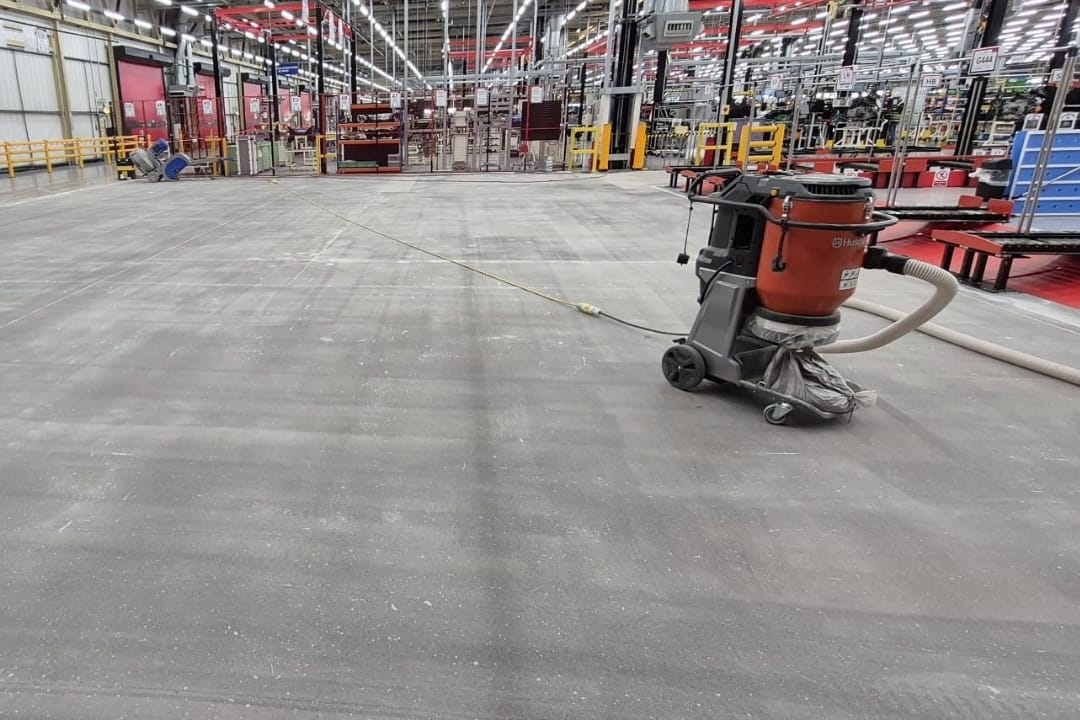
Our grinders and blast machines run with HEPA-rated vacuum extraction that captures airborne silica at source, keeping live commercial and industrial sites operational, protecting staff and removing the clean-up burden of uncontrolled dust. Every surface is prepared to a defined concrete surface profile matched to the coating or finish being applied, giving resin, epoxy and polished systems the bond strength to resist delamination, chipping and load stress.
Removing high spots, ridges and contamination first also produces a flat, uniform plane that carries through to a sharper polished floor or a flawless coated surface. Preparation determines lifespan: a floor bonded to a sound, keyed and level base withstands forklift traffic, impact and chemical exposure far longer, reducing the cost of premature repair or recoating.
Types of Concrete Surface Preparation
We select the right process, or combination of processes, for the substrate condition and the specified finish.
Shot Blasting
Shot blasting concrete propels steel shot across the slab at high velocity, stripping laitance, coatings and contaminants while imparting an even, textured profile. It is the fastest, most consistent method for large areas and the standard preparation for resin and epoxy systems.
Grit Blasting
Grit blasting uses an abrasive media stream to clean and profile tighter or more intricate areas, and to key harder surfaces where a more aggressive cut is needed. It is well suited to detail work, edges and localised remediation.
Scabbling
Scabbling concrete removes material more aggressively than grinding or blasting, using percussive heads to take back damaged, heavily contaminated or uneven surfaces. Scabbling concrete surfaces is the correct choice where several millimetres of failed substrate must be removed before rebuilding.
Base Preparation
Base preparation for concrete readies the substrate for what comes next, whether that is a new screed, a repair overlay or a resin build-up. Sound concrete base preparation corrects levels, removes weak material and establishes a stable, clean platform for the specified system.
Diamond Grinding
Diamond grinding concrete uses diamond-segmented tooling to flatten, smooth and refine the surface with fine control. Diamond floor grinding is used both to prepare a slab for coatings and to open concrete ahead of polishing, and it is the primary process behind industrial polished concrete floors.
Concrete Surface Preparation Applications

Food and Drink Manufacturing
Correctly profiled concrete is necessary for the hygienic resin systems these sites depend on, ensuring coatings bond fully and leave no voids for contamination.

Chemical Manufacturing
Concrete grinding and blasting expose sound concrete and create the profile needed for the chemically resistant coatings that protect the slab from aggressive spillage and attack.

Pharmaceutical Production
Dust-free preparation creates the sound, sealed-ready profile required for hygienic, low-particulate resin finishes.

Industrial Plants
Preparation exposes sound concrete and creates the profile needed for coatings that must withstand impact, chemical spillage and constant load.
Concrete Preparation Process
We deliver every project through a controlled three-stage process built around the concrete surface profile.
We begin by surveying the substrate: testing soundness, moisture and existing contamination, identifying level variance, and confirming the concrete surface profile (CSP) required by the specified finish. This assessment determines the method, the tooling and the sequence.
We carry out the preparation using the selected combination of grinding, blasting or scabbling, all under dust-free extraction. The team works to the defined CSP across the full area, correcting levels and exposing a sound, consistent surface as they progress.
We inspect the finished substrate against the target concrete surface profile, verifying texture, cleanliness and flatness before any finish is applied. Only a surface that meets the specification is signed off and handed to the coating or polishing stage.
Concrete Preparation Images
Browse the gallery below to see our concrete surface preparation in progress and completed, from diamond ground slabs to shot-blasted floors ready for coating.


Let’s kickstart your project!

Request a free survey
Start with a Free Survey. We assess your needs and offer tailored recommendations, costs and proposed work.

Seamless installation
Our team of qualified specialists arrive to begin the proposed work.

Inspection & quality control
Our team of experts will complete a thorough check of the work undertaken and provide any maintenance information.

I have questions…
ST2 is thorough hand and power-tool cleaning that removes loose material and most contamination, while ST3 is a more rigorous version that produces a brighter, sounder surface with a stronger mechanical key. ST3 is specified where higher coating adhesion and durability are required.
The three principal mechanical methods are diamond grinding, shot or grit blasting, and scabbling. Each removes surface material and imparts a profile to a different depth and texture, so the choice depends on substrate condition and the finish being applied.
No, grinding is a surface-refinement process that typically removes only a few millimetres. Removing two inches of concrete requires scabbling or planing, which we can carry out where heavy material removal is needed before rebuilding the surface.
It depends on the method: wet grinding controls dust and extends diamond tooling life, but most industrial preparation is done dry with vacuum extraction for a cleaner, immediately coating-ready surface. We select the approach based on the site, the finish and dust-control requirements.
Only if the ground floor is being left exposed, in which case sealing protects against dust, staining and moisture ingress. If a resin, epoxy or polished system is being applied, the ground profile is the bond surface and no separate seal is needed.
Cost varies with area size, substrate condition and the finish required, typically ranging from around £15 to £40 per m2 in the UK. We provide a fixed price per project once we have assessed the slab on site.
Not with our equipment: our grinders run with HEPA-rated vacuum extraction that captures dust and silica at source. This keeps the surrounding area clean and allows us to work in live industrial environments.
As a rule, allow 28 days for the concrete to reach full cure and strength before grinding or heavy preparation. Light surface preparation can sometimes begin sooner, depending on the mix design and site conditions.
New concrete carries laitance and curing compounds that block adhesion, while existing floors hold contaminants and failed coatings that undermine anything laid over them. Both require mechanical preparation to create a sound, keyed and level surface that a finish can bond to.
A CSP is the industry-recognised measure of surface roughness, graded from CSP 1 to CSP 9, that determines how well a coating will bond to the slab. Matching the profile to the specified system is what prevents delamination and coating failure, which is why we verify it before handover.
Get a FREE, no obligation survey
To get started, fill out our form to request a Free Survey. We’ll assess your needs and offer tailored recommendations, costs and proposed work.

